Competitive prices for top quality
The floriculture sector is constantly evolving, but few trends have had such a lasting impact on business operations as the resurgence of dried flowers. While this product once had a dusty image, it is now an essential part of the assortment of modern florists and interior stylists. For you as a grower or trader, this offers enormous opportunities. The biggest advantage? You are less dependent on the volatile, daily fresh market. In this blog, we dive deep into the world of seeds specifically suitable for dry production and how to optimize cultivation for maximum yield.

Growing flowers for the drying industry requires a different mindset compared to traditional cut flower cultivation. With fresh flowers, everything revolves around extending vase life; with dried flowers, everything revolves around preserving cell structure and pigment after moisture loss. When you invest in the right seeds, you create a product that doesn't have to be consumed within seven days, but retains its value for months. This reduces pressure on your logistics chain and minimizes spoilage.
The success of a high-quality dried flower begins with genetics. At Easyseeds, we select varieties that have been specifically bred for stem firmness and colorfastness. A number of indispensable varieties for the professional grower:
As a professional grower, you know that the propagation phase lays the foundation for the final quality. With dried flowers, you want to prevent the stems from becoming too fleshy or watery.
Most dried flower seeds thrive best with controlled cultivation in trays. Use a substrate with a fine texture and a balanced ratio of air to moisture. For Helichrysum , we recommend a constant temperature of 20°C for uniform germination. Please note: many of these species are light germinators. This means that you should only cover the seeds very thinly with vermiculite to prevent drying out, while still allowing light to pass through.
Inopen ground or in a greenhouse, planting distance is crucial. For the dry market, aim for long, straight stems without too many side branches at the base. By maintaining a higher planting density, you force the plants to compete for light, resulting in the desired length. Use support netting to prevent the stems from bending; a crooked dried flower is virtually worthless commercially.
Be cautious with nitrogen during the ripening phase. Too much nitrogen causes rapid cell elongation but weak cell walls. This takes its toll during the drying process: the stems buckle or become brittle. Focus instead on potassium to promote tissue firmness.
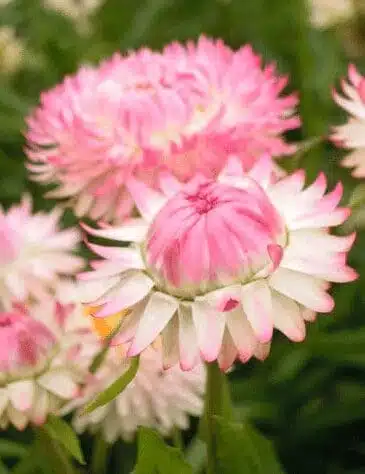
The timing of the harvest determines whether you deliver a top-quality product or a leftover batch. For many dried flowers, the rule applies: it is better to harvest too early than too late.
By including dried flowers in your cropping plan, you spread your business risk. Wholesale demand for high-quality dried flowers continues to rise, partly due to the sustainability claim: after all, they last for years and require no water. Moreover, you can build up a 'stock' with dried flowers. While a surplus of fresh tulips means an immediate loss, a surplus of dried flowers is simply stock that can be sold at a good price at a later time (for example, during the busy Christmas period or leading up to Valentine's Day).
At Easyseeds, we are happy to help you select the right seed batches. Our focus is on profitable varieties that meet the high standards of modern trade.
Do you want to be the first to know about new seeds, special offers, and exclusive growing tips??
Sign up for the Easyseeds.eu newsletter today Easyseeds.eu nieuwsbrief!
✅ Receive practical growing guides and seasonal tips
✅ Stay inspired monthly by the latest products and trends
✅ Be the first to benefit from great promotions and exclusive deals
👉 Registration is free and easy!